Showing posts with label Technology. Show all posts

Thursday, December 15, 2011

Is time travel possible? (Einstein, Mallett and the Large Hadron Collider)

I wrote very briefly back in 2006 that I think time travel is possible. I have always believed that time travel is possible. What I have not known is whether it could come about in my life time or not. I have never gone into this deeply on my blog, mostly because people do not like to entertain this topic. Some of my recent reading has led me to realise that it is an area of physics that is now being seriously researched. Finally I can begin to explore this topic.

Einstein's theories prove time travel forward is possible
Einstein opened up the possibility of time travel being a serious scientific concept through his two theories: the general theory of relativity and the special theory of relativity. The special theory of relativity says that when an object travels fast enough time slows down.

I.e  Repeated experiments have shown the following:
- An atomic clock was placed on a jet plane.
- A corresponding atomic clock was placed on the ground, with exactly the same time.
- The jet plane flew in the sky at a speed approaching sound.
- When the plane landed, its clock was fractionally behind the clock on the ground.

As mentioned, this experiment has been carried out many times. There was nothing wrong with the clocks. This experiment was carried out by physicists seeking to prove Einstein's special theory of relativity. The pilot on those flights had actually jumped forward in time, although only by a very small amount.
Travel at much faster speeds would allow the traveler to jump even further forward in time. Consider a space ship that traveled out into space at close to the speed of light. Traveling at that speed for a journey of two years and back would occur while over 200 years passed on earth. This is based on exactly the same theory as the jet plane and atomic clock experiment. This a widely accepted theory in physics that says that it is possible to jump forward in time.

There is another method of jumping forward in time that is theoretically possible. Black holes can bend space and time, allowing a jump forward or back in time. Black holes could of course tear part what ever objects traveled through them.
Another method again is a worm hole. A worm hole is currently theoretical, but it connects two different places of space and time.

Building a time machine employing the physics of a black hole would require the ability to manipulate the energy of an entire star. So it is still very theoretical.

What ever the case, it must first be established that time travel forward has already been proven as theoretically possible.

Examples of time travel in every day life

I am sitting on the couch here typing my blog on the laptop. My son is currently sitting in another room playing with his toys. I can see him and hear him, yet he is actually in the past. The light traveling from him and the sound traveling from him take time to get to me. All people around us are actually in a different frame of time to our own.
Another example comes from the form of videos and photos. We are capable of watching past events that have been recorded on film or video. This would not be possible if the machine (video camera) that captures these past events had not yet been made. This means, that it is impossible for us to view events before the camera had been invented. The camera does give us a glimpse into the past, a sort of time travel for the brain.

Backwards time travel has always been refuted
Many have argued that although it is theoretically possible to travel forwards in time at great leaps, that it is impossible to travel backwards in time. There is however a modern physicist whose research questions this very notion. His name is Dr. Ronald Mallett, and he is a professor of physics at the University of Connecticut. He has an interesting story. His research boiled down says that gravity can affect time (as in a black hole), and that light can affect gravity. His research has been in black holes and lasers for much of his career. His theory is that light by affecting gravity, can affect time.

Mallett explains that light can make space swirl around, in the same way that a teaspoon can stir water in a coffee cup. If a cube of sugar is thrown into the swirling coffee it can be observed swirling around. In the same way a particle thrown into swirling space can also be observed.
Mallett theorises, that when such a machine is built it will be possible to send particles back in time, but only to any point when the machine is already switched on. I.e If it were switched on today, December 15h, 2011, then from any point in the future a particle could be sent back to today or any day after today. A particle could not be sent back to December 14th or any earlier day. This is much the same as the fact that film can not be made before the date that the camera was invented.

If Mallett successfully makes his time machine, we will not be able to travel in time as people, but it will be a significant leap in the theory of time travel.


The Large Hadron Collider in Switzerland.


The Large Hadron Collider is a large underground tunnel 27 km in circumference, not unlike a synchrotron. Its designed purpose is to collide protons and other sub atomic particles with one another. It is hoped that many things will be discovered about the nature of sub atomic particles. Further than that it is hoped that layers below the sub-atomic such as the existence of a Higgs-boson particle can either be proven or disproven. It is also hoped that the nature of dark matter can be understood through experiments.
All of these experiments will no doubt bring far greater understanding to the nature of physics, giving greater context to the concept of time travel.
Before the collider was switched on there were some people who tried to take out legal injunctions against its procession. They claimed that the experiments could open up black holes that could suck the earth up. It is true that experiments at the collider could indeed create black holes, but none with any sufficient power to suck the earth up. It has also been postulated that the experiments could open up tiny worm holes.
And now for the slightly tongue in cheek question. Are they actually building a time machine at CERN in Switzerland?
(For now I am happy to take all experiments as above board. But I do find it uncanny that the Large Hadron Collider is capable of sending protons at "3 metres per second less than the speed of light." This sounds potentially like a very large model of what Dr. Ronald Mallett is currently attempting to build.)

It is actually possible that activities at the Large Hadron Collider could be paving the way for time travel to occur, by the creation of worm holes, or at the very least by a far deeper understanding of physics.

Conclusions
The physics is there to theoretically prove that time travel is possible. Personally I get excited by this stuff. The practicality for people to time travel could still be a long way off. The possibility of sending particles through time may not be far away. It may even be possible to send messages through time.
For someone to travel backwards in time, there would have to already be a working time machine on the date in the past. Therefore if someone claims today that they are a time traveler the easiest way to test this is to see their time machine.
The possible existence of wormholes however could contradict the theory that a time machine must be present in the past. It may simply be possible to travel through a worm hole. It may not be possible however to choose where and when these worm holes go, and if it is possible to return.


Thursday, November 03, 2011

Carbon pollution- my conspiracy theory


And now for my conspiracy theory. Before I drop my bomb shell, may I go on the record as saying I am an environmentalist and I do despise pollution. I do believe in clean energy and I do hope for a cleaner tomorrow.

Here's my bombshell. Global warming induced by carbon pollution is a croc!

That does not necessarily mean I do no think that climate change could be occurring. But let me leave that  argument for a little later. I am saying that I think the theory that says carbon and fossil fuels are causing the atmosphere to overheat, is a conspiracy.

Instead of stringing you along let me give my reason first and then attempt to back it up.

Here are some facts:
-Global oil supply will not last for ever. Pessimists say that oil supply is already in decline. Optimists say that the peak of oil production will come in 2020 or even a little later. After this point the amount of global oil supply will reach its peak for a season. Once its peak is reached there will be a decline. This is based upon a pattern that has occurred with all oil wells in the past. It is derived from a mathematical formula called the Hubbert Curve. At the point of this decline, the price of oil will begin to sky rocket and people will not be able to afford to drive their oil fuelled cars anymore. Then after that at some point the oil would run out altogether.

-The population of people driving cars in the world is exponentially increasing. This is only speeding up the imbalance between supply and demand when it comes to oil.

So the fact is, the world will run out of oil and people will not be able to run their cars anymore. Without some major long term structural changes to society, entire economies will cease to function as we have become ultra dependent on cars (not to mention the other purposes oil serves).

What is the solution to this problem?
The solution is to get people off an oil dependency on to other forms of energy. This is now so widely accepted that it seems a no-brainer. But it has taken decades of "education" to get people to hold this world view.
That oil is running out, I do not doubt. My theory however is that governments and oil companies of the world have known this fact for decades. In fact it has been known since Hubbert developed his curve in the 50s, and it was predicted that America would reach peak oil production in the late 60s, prompting the oil crisis of the 70s. That oil crisis of the 70s saw a major restructuring in the world- the rise of Arab Oil economies; the decision to make the US Dollar the currency of international trade; the decision to take gold out of the equation as a guarantee for the value of the US Dollar. And those decisions are the bedrock of the current financial crisis in the world.
So my conspiracy theory is that governments made a decision on a strategy to wean the world off oil. And the oil companies convinced the governments to time this strategy for when oil actually started to decline, so that they could still reap maximum profits before that.
The strategy decided upon was to convince the masses to stop using oil and to move to alternative energies. But how could they convince us? We are so car dependent that to simply stop using our cars is madness!!! madness I tell you!!  And why would we voluntarily want to just pay more for alternative energies without a good reason for doing so. Positive incentives never seem to work either on people. So negative incentives had to be found.
It is easier to convince the world that we are all doomed. It is easier to convince the world to stop using oil, because if we don't we will kill our grand children. Negative incentives such as global warming and carbon taxes are invented to convince people that we need to switch to alternative energies. It is a weak claim to say- "just stop using the oil, because you will breathe more cleanly" or "just stop driving the car and get out and walk or ride and enjoy the sunshine."
But with fear as a motivator we are all convinced that we need to do something good for our planet. We don't complain when prices sky rocket, we don't complain where burdensome taxes are placed on us, because it is for the good of the planet and our grandchildren.

So we have been given a different reason to switch to alternative energies than the real reason.

The truth: We need to switch to alternative energies because oil will eventually run out.
The reason people would not believe this truth: It sounds fanciful, distant, and alternative energies have been far more expensive in the short term than oil.

The lie: Oil is killing our planet. We need to switch to alternative energies to stop global warming.

Some incriminating facts that expose the conspiracy:
-Governments have discouraged and forbidden development of electric cars for decades in the past. It has only been in recent years that they are allowing development to go ahead, neatly timed for a transitional switch over as oil supply declines.

-The Australian and State governments are not overly interested in increasing public transport. I.e if they believed that burning oil was damaging to the environment they could take far more effective action in the short term to reduce car usage.

-Very little is being done to switch to alternative energies in Australia. While oil is in danger of running out, there is still plenty of coal to go around in Australia. Coal fired energy plants are increasing, not decreasing. The plants that burn uncleanly are not being cleaned up.

-A carbon tax is simply a method to provide negative incentive, to help people believe the lie that carbon is the killer.

-Al Gore is one of the canaries in the mine that expose the conspiracy. His film "An Inconvenient Truth" is very out dated now because the predictions in it are not even coming true. He is a trader in carbon credits. Carbon trading stands to become a major world wide commodity even by 2015. Mean while Al Gore has a large mansion with multiple cars, and is constantly flying around the world. His actions do not line up with someone who believes in carbon induced global warming.

-On a recent trip to Finland I saw some of the hypocrisy that exists within the European Union. The EU is supposed to be the most responsible when it comes to combating global warming. Petrol prices are extremely high ($2.20 a litre) in Europe, being heavy on the taxes.
Yet I noticed a couple of glaring inconsistencies. In Finland infant milk formula comes in ready serve packages of one litre or even single serve 250ml packages. This means a lot of extra packaging is required, than simply using powder. The Finns have the cleanest water in the world, so water should not be a problem. So much extra energy is spent on all of that unnecessary packaging.
Finland have recently eliminated sea/ surface mail as an option. All mail must now go by air. But as air travel burns so much more fossil fuels than land or sea travel this seems a ridiculous decision to make.

If Finland really believed in carbon induced global warming they would not allow seamail to be eliminated, nor would they allow such copious production of packaging.

Finland has thousands upon thousands of lakes. They have more fresh water than they could ever possibly use. Yet they clean and recycle ALL of their water that they use. They are constantly telling people to use water carefully. A lot of energy needs to be spent on cleaning all of that water.

What about climate change?
I think it is still too early to prove if our climate is completely changing. But there are certainly some signs that point in this direction. But some facts should be taken into account:

-The magnetic north pole is moving in one steady direction away from Canada towards Russia at a pace of 55km a year. At the rate it is going it appears to be on a course to flip. Nobody can really say what affect this could have on climate. What we do know is that the magnetic poles have flipped before. We have also had times of major climate change in the past, both warming and cooling of the planet (and they were never affected by carbon pollution).

-The sun is producing an increasing amount of solar flares. Solar flares always account for hotter weather on earth. The sun is the source of all energy on earth. The sun is also responsible for our basic weather of Summer and Winter, based on proximity to the sun. It should be no surprise if the sun is actually the biggest influence in climate change. The sun is far more powerful than any change we can effect as humans.

Conclusions:
I do not deny climate change. I think it is affected by such factors as the movement of the magnetic north pole and increase in solar flares.
I do not think climate change is brought about by global warming, induced by carbon pollution.
We do need to move away from oil usage to alternative energies; but this is because oil will run out and because it's nice to breathe clean air.
Governments have been cooking up the global warming conspiracy for decades as a method of fear to convince us to transition to alternative energies, instead of us being caught in a crisis with no oil and no options.

I can't understand why people prefer to believe a lie and live in fear all their lives? There are far more positive reasons for change and we don't need to be held to ransom by controlling taxing governments.


Friday, October 28, 2011

Car free cities

[Blueprint for a nature immersed car free city.]


Imagine a city, town or region completely free of cars. Cities without cars are more peaceful, less pollutant by far, have closer social ties and are safer. Some are a reality, some are under construction, some are still a vision, some are quite science fiction. This list is a mixture of them all.

Venice
Perhaps the most famous car free place in the world, a city of canals and boats, home to 70,000 people.

Fes-al-Bali
Fes-al-Bali in Morocco is home to 150,000 people, but with a population density of 550 per sq. metre, it is very crowded.

Cheung Chau
An island near Hong Kong city, the majority of the city has streets that are simply too narrow for cars. The city have developed tiny emergency vehicles though. It is home to 23,000 people.

Old City Jerusalem

Old City Jerusalem is also a historical anomaly. Home to 35,000 people it does not have any streets big enough for cars to drive on.

Iquitos
Iquitos in Peru is not particularly safe for pedestrians, but it is novel and therefore fun to include in the list. It is a city with virtually no cars, but motorbikes instead. This is because it is an isolated city, not connected by road to the outside world.


Masdar
Masdar is a new city under construction. It is located outside of Abu-Dhabi in the Arab Emirates. It will be home to 50,000 people and many clean energy companies. It will be the world's first completely energy clean city running on solar, wind and geothermal energy. At $22 billion, that is a fairly modest price tag for such a modern city. Hopefully it will create a blue print for new cities around the world.


Science fiction lily pad city- Ecopolis
Designed by Belgian architect Vincent Callebaut, the Ecopolis is envisaged for a world plagued by rising sea levels.


Lobe city design
Designed by J.H.Crawford of carfree.com , the lobe city is based upon a concept of multiple districts each with their own metro underground train station. Each district then has a population of up to 12,000 people. All of their daily needs are met within their own district. A city made up of 100 or so districts would have a population of 1 million and take up to 45 minutes to travel across.


Why build a completely new city?
There are plenty of people who would love to live in a car free city. But there are also plenty of people opposed to such an idea. Instead of forcing people to transform old cities to car free ones, why not give people the choice of living in a new city better equipped for the purpose.

What is good or bad about the above cities?
Cities like Venice or Fes-al-Bali, Old City Jerusalem and Cheung Chau are steeped in history and culture and they would be intriguing places to live. Of course they probably have very few vacancies, and a move there requires learning a new language and culture.

A city like Iquitos would be unique and less congested than a car based city, but dangerous none the less with mopeds and motor bikes zipping everywhere.

Masdar is the most exciting prospect of the present day because it is a reality. I would be very intrigued to visit there once it is completed and see how it works. One thing Masdar is seriously lacking is nature. It is very concrete based in its environment. They however have worked very hard to make it aesthetically pleasing and the many fountains will surely make it a pleasant place.

The lily pad Ecopolis is novel and science-fictitious. I personally hope that such cities are never necessary, but having said that if people want to live on a lily-pad city it would certainly be very different. It would also be lacking in trees and birds.

The lobe design with multiple districts is a well thought out one. I might design a city differently none the less, but I think it is very likely to work. I would love to see somebody try it.

Another alternative?
There are as many alternatives as there are creative people in the world. My alternative though is a city based upon the idea of buildings and houses being merged with nature as much as possible. This would give the feel of living in a National Park, yet still have all the comforts of a modern city including the Arts and Sports.
My blue print for such a city is here.

A location for such a city?
There are many possible locations, but one such location is particularly appealing from an Australian context. French Island in Western Port Bay is already a car free zone. Seventy people live there and two thirds of the island is National Park. It has a rich Koala population that regularly exports Koalas to the mainland to keep the local population in check.

An ecologically friendly city could be built here that would not interrupt the flora or fauna at all. A high speed railway could be built from the island to the near by city of Melbourne, giving the residents of French Island access to the culture of a big city. The goal would still be to attract tertiary industry to the island so that residents could be employed there and have their community life there.


Thursday, October 27, 2011

Imagine a city without cars (a city in a nature park)

A parkland area in central Helsinki where there are very few cars. Houses and apartment buildings are amongst the parks and gardens. Being there recently reminded me of my dream for a carless city.
The Dream
For some years I have dreamed of a city without cars. I think the first time I did this was back in 2003. I had been living in the country side in Canada for a couple of years. I had grown accustomed to a quieter more peaceful life. I then returned to work in Melbourne, Australia. I did not have a car at first, catching the bus to work every day. As I would stand at the bus stop I would watch the cars rush by, and I would listen to all the noise they made. My first reaction was not "if only I had a car too" but rather "those tyres make so much noise, imagine if there was no noise coming from cars."

Imagine if there was no noise coming from cars. I looked at the trees and the birds, and whilst I was happy that they still existed in suburban Melbourne, I dreamed of living in a place where they would be abundant. I sat down and began to flesh out my ideas on paper. I dreamed of houses and buildings almost hidden amongst the trees. Some buildings could even be built into the hillside, if hills existed. Or some buildings could be landscaped to be a part of nature, perhaps partly underground with some grass and shrubbery above the house. A life that is lived closer to nature is a more peaceful one, but this can still be done with modern comforts.

I mapped out what my city might look like. It would have an extensive system of underground railways. This would make travel to any part of the city possible within a short trip of perhaps no more than 10-15 minutes. Above ground there would not be roads as such. Instead there would be many paths for people to walk on and for bikes to ride on. There would be plenty of park land where there are no buildings at all, but the over all feel of the place would actually be that of park land, where animals would roam freely.

Obstacles
A paradise is often too good to be true, and many issues would arise with building such a city from scratch. The first one that comes to mind is- how would deliveries be carried out. There are multiple possible solutions to such a problem. Deliveries could be carried out by animal if people desire to keep one. Deliveries could also be carried out on electric carts that would only be available with a special license purely for the purpose of delivery. These carts would even be capable of carrying building materials should a new building be constructed. An underground conveyor belt system complete with delivery chutes would also be possible, but likely a lot more expensive.

Another issue that arises is enticing people to live in such a city in the first place. People like to live in cities because of all the cultural activities that they offer. Setting up in a new city always costs people money too and would be a disincentive.

It is worth pointing out that the benefits of such a city would be a far less stressful life, but also of much benefit to the environment. So much energy is spent on making cars in the first place, and then they require so much energy to run, and they present dangers to people. Cars also take up so much of people's lives as they sit in traffic, destroying the social fabric of communities. (The city I currently live in regularly has two hour traffic jams.)

Plan of implementation
- Tax incentives for corporations, companies and businesses to set up in the new city. All would be tax free for the first ten years of the city's life. Following the first ten years there would be a gradation process. Full taxes would not be paid until the city was already 50 years old.
- A modern city would likely only have tertiary industry. Heavy scaled manufacturing if needed in the the vicinity of the city would happen outside the city.
- As corporations choose to set up in the new tax haven, workers would also need to be enticed. All residents of the city would be on a similar tax incentive scheme to companies. Wages would still be kept in line with the rest of the country, ensuring a tax minimum life for the new residents.
- (These tax incentives are necessary to entice people to try something new. Once the first such city got off the ground there would be a deepening desire from other people to join the new car free life.)

- Assuming both industry and workers are present in the equation, there needs to be other factors necessary to entice residents. Cultural facilities such as concert halls, theatres, entertainment complexes, sporting facilities for public participation and professional sporting stadiums would be built. Securing a professional sporting team to make the city its home would be a big part of the equation.

- The city would be built completely away from the car grid altogether. In the 21st century very fast trains exist that can travel to 400 km/h. Such a train would connect the city with the rest of the country. An airport would not be necessary, and would not fit in with the philosophy of minimising oil use in the world. If the city is on the coast of a country, then it would also be serviced by shipping.

Why plan a city?
The idea of planning a city from scratch is not such a crazy one. Cities have been planned in the past, and they are usually peaceful places to live. In Australia the cities of Adelaide and Canberra have been extensively planned. Adelaide is a far older city than Canberra. Both cities of course depend on cars, but even their planning has resulted in free flowing traffic, even if there is the noise to live with. Planning a city goes a very long way to making life there comfortable. The inner suburbs of Melbourne were planned, but the growth past that point has made for a messy city.

How would such a city be financed? From a variety of angles. Corporations would take part in building their share. They could even have shares in the city. Investors and entrepreneurs could put up funds, to which they would undoubtedly see handsome returns. It would of course require assistance from government, and it would of course require visionaries to build and invest in the dream.

Parting thoughts
The dream is a worthy one to see come to fruition. The world badly needs to be set free from the burden of cars. The world badly needs more environmentally friendly solutions for the future. The carless city could indeed be the city of the future and not a pipe dream.

I may be no real expert in city planning. I have taken the path of linguistics in my life. That does not mean I can not have opinions on issues of the environment and sustainable, ecological and healthy living. It is my humble hope that such cities will come about in the world. If you happen to be an entrepreneur or politician feel free to run with these ideas. Heck, even feel free to take the credit for yourself. I would just be happy to see it happen.


__________________________________________________________________________________
Appendix issues:
Existent cities
But what of the cities that already exist? Surely they can not just be shut down and replaces by the city of the future? Well, no of course not. Existent cities would need to evolve towards being carless over time. Taking the example I know best, I will speak of Melbourne in Australia. I do not live in Melbourne anymore, but I do hear the complaints coming from there that the roads are buckling under the strain, as is the train system. Melbourne needs to bite the bullet at some point before things get better. All of the level railway crossings need to be removed from the city. (There are currently hundreds and they slow down traffic a lot.) Underground train lines should be put in where ever there are above group train lines. These lines could be newer and higher quality with much faster trains, cutting down travel time extensively. (The Moscow under ground Metro is a lot faster than the Melbourne above ground Metro.) The land above the railway lines could be partly sold to pay for the venture and partly established with "bike highways". Bike highways would enable cyclists to travel into the centre for work without having to fight traffic or stop for red lights. This is just one example of an evolutionary step that needs to be taken in Melbourne. In time, some roads could be replaced with more underground train lines beneath them and bike highways above them. Gradually the city could be weaned off its addiction to the car.

Location of new city
Where would such a city be built? Around the world different countries would afford different opportunities. Again, in Australia I can think of various locations for such a city. Australians are very coastal people. It would be a difficult draw card to build such a city without people having access to the beach. Suddenly that means that there are very few apparent vacancies around the country. But this is not actually true. 
A variety of options exist:
- An isolated part of the South Australian or Western Australian coastline. This would require a lot of work to revegetate and irrigate. It is perhaps a good location for a future city, but may have drawbacks in drawing people there initially.
- A tropical part of the coast of Gulf of Carpentaria currently uninhabited. This would not have problems with vegetation, but not all are drawn to a tropical climate.
- The most densely populated state in Australia is actually Victoria. In some ways it makes sense to find a coastal location in Victoria. A location half way between Portland and Port Fairy is currently being used as farm land and has a highway going through it. The highway could be moved to go north of the proposed city. Portland already is a large deep water shipping port which could easily service the city.

Carfree cities already around the world
There are actually some places in the world that already are car free. Most of these came about due to historical reasons. Venice in Italy with a population of 70,000 is one such example. It exists on a network of canals. Fes-el-Bali in Morocco is the old part of a newer city. It is only a small area covering 2.4 kms by 1.6 kms, but has a population of 150,000.
Other such parts of the world are more often islands that never allowed cars in the first place.

Each of these historical places that are car free are however not immersed in nature as my proposed city is, nor do they have mass transit systems.

Finally, there is one modern city that is being established as car free. Masdar is near Abu Dhabi in the Emirates. It also will not be a nature immersed city, but it will be energy clean.

For more information on car free locations around the world there is a website worth reading: car free.com
There is also a list of car free locations around the world on wikipedia.


Wednesday, March 24, 2010

Why I quit facebook aka... Myface or Spacebook


Yep, that's right I deleted my account. It wasn't easy to do I can tell you. There used to be a simple function under account settings, but it is now hidden deep within the dungeon of their administration. Even when I did "delete" I was informed that there is a 14 day cooling off period. If I were to log in within the next couple weeks, it would be as if nothing happened. But I'll show them! I have kicked their narcotic I tell you.

Facebook is a bit of a social experiment gone wrong. I have found myself in far too many debates with people over the last few years. Some people love a good debate. Some can't stand it. The simple fact is that many people use facebook for their own reasons, but if they are different to your own, then they are not quite compatible.

It is far too easy to say things that you would never quite say in real life. That is, the thought may be the same, but it is often phrased differently on facebook. I have certainly done this, that's for sure. Too often I have taken my opinion and thrown a little bit of a spin on it to ruffle people's feathers and try to get a debate going. This has had some distasteful consequences.

In short, I am aware that I have offended people with my opinions at times. I have never been one to hide my opinions in life, and have also been overly enthusiastic in wanting others to understand me, and even agree with me. In short, I am humbled and apologetic for causing this hurt to people, some that I know about, and some that I don't. I only hope that I have the chance to apologise properly to those that I have hurt.

Now that facebook is gone, I'm happier. :) No more banal triviality for me. No more consuming myself in various debates, all the while feeling a little sick about it. Life is more peaceful again. I can feel the soft breeze of reality blowing back in to the room. I can blog again. I really need to blog again. It's a thousand times more therapeutic for me, and I know that there will always be some that will want to interact with me.

In real life there is always the chance to speak back instantly. In real life respect is mandatory (in my book anyway). The recent experiment called "Chat Roulette" shows just how far the virtual reality world can go, deep in to places where people have no anchor for their psyche, and will undoubtedy get lost in a treacherous outer space squall.

I'm getting back to the Nescafe ads, LOL in person.

Blogs are second best hey?! :)

Tuesday, March 11, 2008

iPod touch- no pairing record (welcome confused iPod users)

I have been quite surprised by the number of people who have come to my blog in the last few days because of the problem they have been having with their iPod. There are LOTS of people out there with the same problem. I think it may be a problem with software update 1.1.3. If you are able to get it working and update to 1.1.4 then the problem should hopefully go away. Read the post below for the story. If my experience does not help you, call the technical assistance line and make sure they help you, don't let them get away with anything. (Number in post below).

I have a new gripe now. I can only charge the iPod touch through iTunes on my computer. I have a separate usb hub and can not charge it there. That does not make logical sense to me. If electricity is all that is needed to charge then it should work through the usb hub overnight when the computer is off. I don't want to have spend extra money to buy a special charger just so I can use my iPod on a trip when I don't want to take my computer. I'm kind of annoyed now. Does anyone have any advice on this matter.

Since you have arrived at my blog, please feel free to look around. There may be some other topics that interest you. Just have a look at the labels in the side column. Good luck with your iPod. You'll get it working eventually.

Saturday, March 08, 2008

iPod touch- no pairing record

When I knew a friend was going to the States, I decided I would buy a new iPod. For the last two years I have had a 512mb shuffle. Some people I know have even made fun of me, but I am secure in my iDentity. I have wanted an iPod for a long time. It's my birthday this month. My wife kindly let me have the iPod touch as an early birthday present. I refrained from getting the iPhone for a number of reasons, not the least that the ongoing expense would currently be quite high. I guess I will upgrade to an iPhone within a couple of years.

The retail price in the States was $299. Plus tax it was $307. I forked out 7500 rubles (conversion based on date of internet purchase) which worked out to be $339 AUD, a $60 saving on the Australian retail price of $399.

My friend arrived yesterday and I picked up the package this morning. The presentation was classy.

The box was small and shiny. Although, I would rather have had U2 on the front than John Lennon. He's never gettin' in to my iTunes.

I calmly walked home and even picked up some groceries on the way.

Out it came from the box.

Still shiny, still happy.


It's really thin too- 8mm x 61mm x 110mm.

Next came the exciting moment, plugging the usb cable into the computer. iTunes did not open by itself. I waited a while. I opened iTunes manually. "iTunes is unable to connect the iPod "iPOd" because the pairing record is missing." Arrrrgh!! What could be wrong. I wasn't happy. I disconnected and tried again. Still the "pairing record" was missing. I was beginning to freak out. $340 and all I had was a shiny looking (albeit wafer thin) brick. After four tries I was dismayed and ringing friends. I found out I could call Apple Customer Service (US) 1800 MYAPPLE. When I did get through, I was told that I could call technical support when they open, but was shown very little sympathy. The shine was really beginning to wear off.

Some forums spoke of other people having the same problem. I stumbled upon one person saying that it worked for them on the sixth try. Another person said to try a different usb port. I tried the all faithful restart on the computer. My wife sat down to have a go, I suggested trying a different port, and thankfully it worked that time. I still think I will ring Apple Technical support. If you have found my blog and you want to speak with them their number is (US) 1800 275 2273. If you are calling outside the US, use your international code first. I called on Skype and it was still a free call.

I intend to call them now, and ask them what the situation is......

As far as the iPod is concerned, I am still very happy. Unfortunately, my internet provider has me set up on VPN. I will have to install Leopard before I can do VPN sharing and be able to use my iPod online. It will still work in wireless cafes though.

..... I'm on hold right now, while the consultant checks with the "product specialist".

....."It was a problem with the Apple ID"

....."excuse me, I don't understand, could you explain that to me"

....."I will transfer you to the product specialist."

On hold again.


The product itself is extremely intuitive. Even my 2 1/2 year old daughter could work it. I showed it to her and she immediately said "clock!" and pressed the clock button. She also found it very easy to scroll through photos.

I have my "answer" from Apple technical support. It was rather vague. There was possibly some confusion with the Apple ID (the one I use to log in to the iTunes store). I don't believe the explanation. It would explain the problem if the ipod was already connected, but not the very first time I took it out of the box. Apparently restarting the computer was the right thing to do.

God help you if restarting the computer does not help.

And God help you, if it doesn't work and you live in a place a loooong way from Apple support.

P.S (Since you have taken the time to read my blog, please feel free to have a look around if anything else interests you. The labels in the side column are a good starting point.)

Wednesday, January 17, 2007

The phone or the computer?

In an earlier post I wrote about the concept of merging technologies. I have been predicting (it's not like this is a genius prediction), that eventually we will all walk around with hand held communication devices that carry out all needs; i.e the applications of a computer, internet, television, stereo, telephone, video conference, camera, photo album... the list goes on. These devices will carry out every conceivable communication concept we can come up with.

The iPod has been filling a niche in the market based upon that which is cool and young people demand. It started out as a simple mp3 player, then Apple improved the display and design, then eventually video was added. A new product is being released this year which is the next big step in the internet revolution: the iPhone.

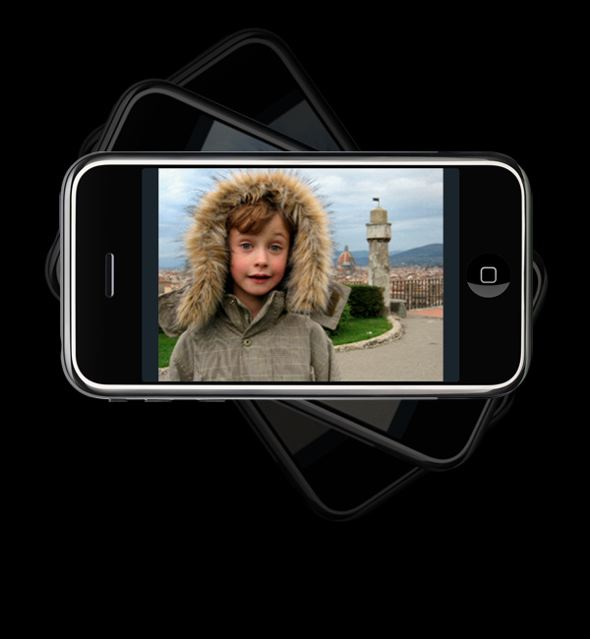
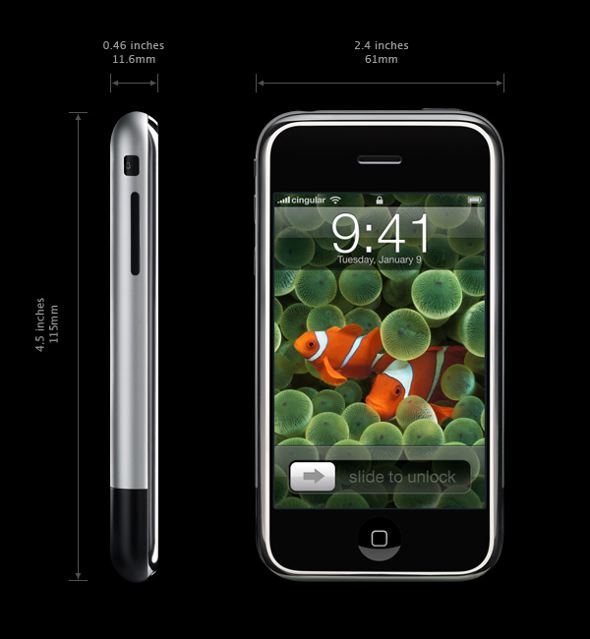
Watch your tv shows or movies, with this full screen display. Show of your slideshows of photos. Notice on the right that there is an iSight camera. (2 megapixels).


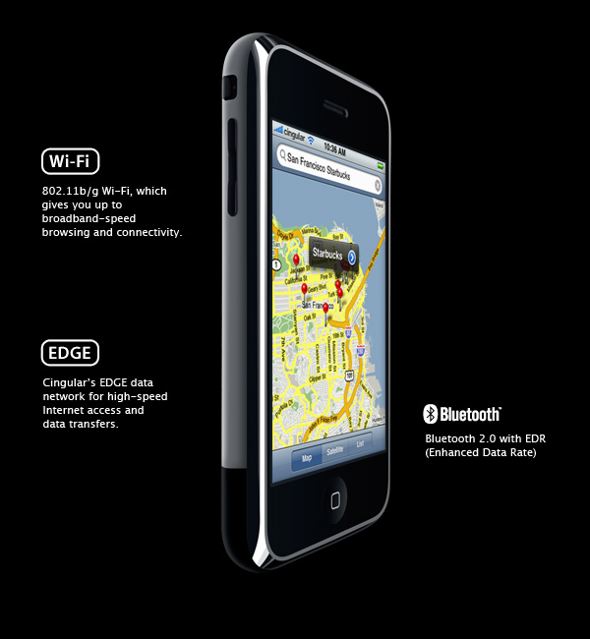
The phone carries GSM coverage for mobile calls. The internet can be accessed this way. The phone also comes with Airport (or Wi-Fi), so the internet can be accessed in a cafe without racking up mobile charges.


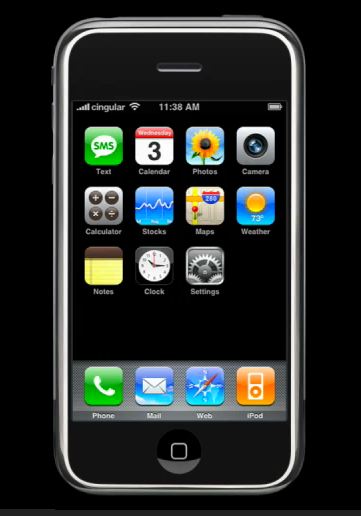
There are multiple software applications. Future versions are bound to be capable of carrying out many more applicatons. There is every application that one could hope for in a PDA.


The web browser enables viewing of web pages as they were designed to be viewed.


The screen is fully touch sensitive and intuitive. It has text predictive typing which means that a full keypad is not required.
Choose your music simply by touching it.


The next question is, as these technologies merge, what will we call this device? A computer, a phone, something else? This will be interesting to see how our language develops.

Thursday, July 13, 2006

Merging technologies


I had these ideas floating around my head months ago, but many of them have leaked out. I suppose I will record just a few of them here and build on them when the ideas come back to me.

Prediction 2015: We will all carry little communication devices. We will no longer call a computer a computer. Our cell phones, computers, television and all means of communication and media will be merged into one device.

This device will connect in to a wireless internet. Video conferencing will be very common and very cheap. If you so desire you will be able to talk to someone face to face from Mt Bogong to the Ural mountains.

The devices will project an image in the air and will thus not require screens.

You will be able to record all of your thoughts through speech. This raises questions about literacy, but a new kind of literacy will develop. It would still be possible to have a keyboard projected by laser on to any flat surface for typing.

You will be able to record your data on to cards if you so choose or an a server at your own home or on a server owned by an ISP, the choice will be yours.

The communication device will be handy in giving multimedia, powerpoint type presentations. You will simply be able to put the device on a table and project your images on to a wall.

Developments possible but not included in 2015:

Running the electricity from the charge in your body, you will never need to recharge batteries again.
Technology that can read your brain waves would enable you to simply think your commands to the device.
This same technology will be further developed to allow you to receive messages from the device. it will have to be your choice whether to have this feature turned on, just as it will be your choice if the device itself is switched on.

Prediction 2050-2100:
The device will have incorporated the above features. An individual on one side of the world will simply think "I would like to say hello to my brother in Brazil." At that direct thought a message is sent to his device to ask him if he wants to speak. Upon his reception of the "call" a virtual face to face conversation could be held, with or without the use of voices.

This is the potential of the technology we already have today.