Showing posts with label Astronomy. Show all posts

Wednesday, January 01, 2014

To preach or not to preach?


When is it an appropriate time to preach the gospel, and when is it not? Is it possible to be too forceful in our presentation of the gospel to people? Is there a time to not preach the gospel?

Even as I ask these questions I hear a myriad of responses from people who will likely not agree with me. I will try to answer some of these, but know that people will want to throw more at me.

The first and most important thing to remember is some of the ways that we are actually exhorted to preach the gospel. A couple of examples come to mind. Peter says that we should always be ready to give a reason for the hope that is in us. (1 Peter 3:15) That is be ready, but this does not mean, always preach. Another is when Paul tells Timothy to "be prepared in season and out of season". Again, this is about preparation and readiness, but does not mean to always preach regardless of the season. (2 Timothy 4:2).
Paul also teaches that people can not believe unless they have heard. (Romans 10:14) There is a strong implication here that the gospel must be taken to everyone. But are we actually required to take the gospel to every individual, or is our individualistic world view an obstruction to the gospel? Jesus teaches that the gospel must be preached to all nations. In fact there really is an approach to the gospel in scripture that is more centred on nations than on individuals. This could be unpacked quite extensively.

When Peter tells people to be ready to share the gospel, he tells them to do it with gentleness and respect. I would argue that this is something that often gets left out. In fact many Evangelicals often take the approach that their only job is to preach, often without any love at all, and that once they have "preached" their responsibility is done. Often such people are very quick to damn someone to hell if they do not listen to a forceful presentation.

Therefore, I want to challenge the evangelical presupposition that we should preach the gospel to every individual and propose that we should only do so when someone is ready to listen. (I am sure this sounds heretical to some, and at least highly controversial to others.) Let me present from scripture why I believe this to be so.

A key concept in understanding the preaching of the gospel is how Jesus did it. Jesus did not in fact preach to everyone. John the Baptist prepared the way for Jesus. A key part of this was the baptism for the repentance of sins. A maxim is used to refer to how many received this baptism- all of Judea, minus the rebellious pharisees. So for starters, Jesus was not actually too interested in preaching to rebellious pharisees. Most of his conversations with the pharisees saw Jesus answering the pharisees attacks, but doing so in ways to cryptically throw them off their attacks. Other times when the masses followed Jesus, Jesus preached in such a way as to again be cryptic, telling parables so that people would be "ever hearing, but not understanding", so that only those who were really hungry would seek the truth. (Mark 4:12, Matthew 13:14, Acts 28:26, Isaiah 6:9). This is consistent with other things Jesus taught- "blessed are those who hunger and thirst for righteousness" (Matthew 5:6)  and "whoever seeks the truth will find it" (Matthew 7:8).

A lot of that description of Jesus' method sounds a little reactive. That is, so many were flocking to him because of his miracles that he was forced to react in how he preached the truth. He wanted to make sure that he was actually preaching to those who wanted to listen and were not just seeking the fireworks show. A common argument might be, "well, we can't actually compare ourselves to Jesus, we need to do things differently."  But, Jesus was deliberate in actually telling us how to go about preaching the gospel. He was not only reactive, he was proactive.

Jesus did have a plan for spreading the gospel (i.e his message, the truth) to people. He actually outlines this plan very clearly twice in the gospels, in Matthew 10 and Luke 10. Jesus sent out his disciples two by two. Let's have a look at what he told them to do.
1) Jesus told the pairs (among the 72, not just 12, which included women who were among his closest followers) firstly to go into the harvest. (Luke 10:2) That is, the harvest was ready to be collected.* (More on this a bit later).
2) Jesus told them to take nothing with them. In a first century middle east context they could easily go from village to village. The commonality in a 21st century Siberian context is that we should approach a village or other context in need, depending on hospitality.
3) Jesus told his disciples to greet someone's home with "May the peace of God be on your home." If this was received, then it was a key indicator that this person was ready to listen.  If the host did not receive the peace of God, Jesus intended for his disciples to move on, that is not to persist with a person who was not ready or willing to listen.
4) When received, Jesus then wanted his disciples to (a) receive the hospitality offered to them (b) heal the sick and (c) preach the Kingdom of God.
5) When not received in an entire town or location, Jesus basically tells the disciples to move on and not waste their energy on stubborn people.

There is some context worth looking at in the above example. First century Jewish villages had all of God's word and law. They were in no ways naive about what they were rejecting if they chose to reject God's peace and kingdom. When going to an unreached context this needs to be approached a little differently, taking the time to patiently and contextually explain the truth. Unreached people however are not as big a stranger to God's law as we might think, and there is still a time for not preaching even in such an unreached context. Where Jesus told his disciples to shake the dust off their feet in a Jewish context, this could mean going away and praying and waiting to come back in the future in a different context.

Jesus' method is deliberate and proactive. He wants us as his disciples to seek out those who are ready to listen. A good way to refer to such a person is a "person of peace". This method is employed by Jesus many times in his ministry. Jesus seeking out the woman at the well in Samaria is a classic example. He found a specific person who was ready to listen, and through her the doors opened to an entire community where he stayed for a couple days teaching about the Kingdom of God. He actually does the same thing with the man named legion, who he heals from demon possession. That man opened the doors to an entire community when Jesus later returned there. If we are to be deliberate about following Jesus' proactive example, this is the best way to preach the gospel- find a person of peace who is ready to listen and reach an entire community through them. It could even be argued that it is counter productive to do otherwise. We end up spending so much time and energy convincing ones and twos and removing them from their community, where as God has a plan to transform entire communities and see rapid multiplication of the gospel.

The argument needs to come back to the idea of whether we are obligated to share the gospel with every person we meet. Firstly I would say that Jesus' name and truth should always be on our lips. We should not hide our light under a table, we should put it high on a stand for all to see. But, and this is a big BUT, we need to be ready in gentleness and respect to stop when people do not want to listen. This can be very hard for us to do at times. We tend to take it upon ourselves that if we do not give someone a full gospel presentation that they may never have another chance to hear and seem to think we could be personally cosigning them to hell. Surely if we had done more we could have prevented this! Or could we have? Or should we?

I will go on record as saying I am not a calvinist. I really do believe in free choice, given by God. I know my ideas seem inconsistent with this. Perhaps the biggest question we should ask is, who is better at preaching the truth, us or God? Let's have a look at where God does preach to people.

In Psalm 19 we learn:
The heavens proclaim the glory of God
The skies display his craftsmanship
Day after day they continue to speak
Night after night they make him known
There is no speech or language where their voice is not heard
Their message has gone throughout the earth
And their words to all the world

Those are some amazing facts! There is not a language where the voice of God's glory has not been heard. This message has gone to all the world! That is a little staggering to realise, if we think the responsibility is all ours. This means that all ethnicities, all people groups have already been hearing something from God. Our part as disciples is to be obedient, not to question God's methods. He tells us to preach the Kingdom of God, but there is a proactive way we should do this, and a way we should avoid.

Often in theology we reduce God's preaching to a patronising "general revelation". As if to say, "well God can only give some vague message to people himself, and it is up to us to fill in the gaps". Have a look further at the context of Psalm 19. The rest of the Psalm goes on to say what the heavens, the skies are preaching about. Verse 7 and 8 tell us that they are giving us the instructions and commands of the Lord. What? That doesn't make sense surely? Surely God went to great efforts to give us his law, and then to even greater efforts to come as Jesus, the Word made flesh. But Psalm 19 is telling us that God is even teaching us his instructions and commands through his glory being revealed in the skies. Again, our part is to play obedience and bring people to Jesus so they can be disciples and follow Jesus' commands closely. But still, we are not allowed to say that God doesn't do more than simply make people aware of his existence, he preaches so much more to them.

Of course the Romans scripture can not be ignored.
Ever since the world was created, people have seen the earth and sky. Through everything God made, they can clearly see his invisible qualities- his eternal power and divine nature. So they have no excuse for not knowing God. 
This verse (Romans 1:20) actually sounds remarkably similar to Psalm 19, that people can know God from what he has taught us in the sky. This also lines up with Genesis 1, day 4, that God created the stars to bring light on the earth. So we can see from scripture that people in all parts of the world should know something of who God is, something of his glory and even something of his instructions and commands. In fact Paul goes even further in chapter 2 (verses 14-15).
Even Gentiles, who do not have God's written law, show that they know his law when they instinctively obey it, even without having heard it. They demonstrate that God's law is written in their hearts, for their own conscience and thoughts accuse them or tell them they are doing right.
Really, this is quite a lot of scriptural evidence to let us know that God most definitely speaks to all peoples before we ever turn up on the scene.

What this all means is, if someone rejects the peace of God when we bring it, they are cognisant of their actions. This doesn't give us permission to communicate the gospel in a culturally insensitive manner (gentleness and respect = cultural sensitivity), but it does give us permission, in fact even requires us to pull back when people reject God.

We have to consider our actions. So often we can come in with a lot of pride and force and insist that people listen to our entire presentation. This approach is not loving. In fact it's not even wise, not what Jesus asks us to do. Jesus asks us to seek out people who are ready to listen, people who have noticed his glory in creation, people who have God's law in their hearts. When we are obedient to Jesus this way, doors will be opened wide into entire communities or people groups.

This should give us a lot of relief. God is in control. We should not be preaching to everyone the entire gospel presentation. We should be opening our mouths and speaking out God's glory, and when people show their curiosity we have a perfect opportunity to go further.
I can think of times in my own life when I believed that I had to push through and convince someone to listen to me. I can think of times here in Russia where other workers here have sat in taxis or trucks with me and pushed through, handed out tracts when the driver has indicated that they do not want to hear. I can even think of a time, when having told my believing brother that this was insensitive, it lead to a big argument and falling out, because he believed he had to preach the full gospel to everyone he met.

Be ready, be prepared, in season and out of season. Always speak the name of Jesus, do so in love with gentleness and respect. Seek out people of peace who are ready to listen. Remember that God has already been preaching to people. Remember that in obedience our job is to go into the harvest and collect the harvest* that God has already prepared. When people do not want to listen, don't push them. You are not letting them down if you don't give them a "full presentation". God is far better at preaching and revealing his glory to people than we are. Often we can get in the way of God getting through to a person. By our backing off, we give God the chance to keep speaking in his own way. Then when someone is ready our job is to be ready to give the reason for the hope that is within us and hopefully even collect a harvest!

Saturday, April 28, 2012

How the spirits were born and rebelled


On the fourth day of creation, the Lord God created the sun, moon and stars. The sun to have authority over the day, the moon to have authority over the night and the stars to give light on the earth, to send God's messages.
After the Lord God had created the stars they began to dance and sing and worship him as he completed the rest of creation, the sea creatures, the birds, the animals, insects and then finally people. The people were made in God's image.
A little while later after God had finished his creation, one of the stars who was very beautiful said to himself, "I am very, very beautiful, all of the stars worship God, but if I was to sit higher than God, then they would worship me. After all I am very, very beautiful and they should worship me." This star, called the Son of the Morning was filled with pride in his heart, he set himself up against God, so the Lord God cast Son of the Morning Star out of heaven.
Son of the Morning fell down to earth and took on the form of a snake. The snake went to the garden that God had made for the man and the woman, the garden of Eden, in the east. There the snake tempted the woman named Eve to eat the fruit of the tree of the knowledge of good and evil. The woman listened to the snake's deception, she ate the fruit, and so did her husband Adam. The Lord God sent Adam and Eve out of the garden, so that they would not be trapped in evil for ever. The snake slithered away.
Later, after Cain had killed his brother Abel, Adam and Eve had more children. Some of these children decided to worship the Lord God and some did not. Many generations later there was a man named Enoch. Enoch worshiped the Lord God and walked closely with God. When Enoch was 365, God took him up in to heaven.
In the days of Enoch, Son of the Morning Star had another plan to try to destroy God's creation. The Star decided he wanted to take a daughter of man, to be his wife. This was something God had forbidden the stars to do. Their job was to send God's messages to earth and to worship the creator. Son of the Morning Star thought about his plan, he knew he would make God very angry. Instead of doing this by himself, he decided he would convince some other stars to do this with him.
Son of the Morning Star took on the form of a dragon. The dragon flew up to heaven to convince the stars of his plan. When he arrived, the Lord God sent his archangel Michael to war against the dragon. Michael, also a star won this war in heaven on behalf of God. But before the war was finished the dragon had convinced one third of the stars to carry out his evil plan with him. The dragon took his long tail and swept a third of the stars out of the sky. The dragon set out on his plan to torment the nations.
The stars fell down to earth. They took on the form of man this time. These rebellious stars, now looking like men took women for themselves as wives. They had children by these women. These children were known as the Nephilim, they became very powerful. These powerful Nephilim were giants, they were also the gods and legends of the nations around the world. The fallen stars taught the Nephilim magic, and in turn the Nephilim taught the people of earth magic and many other evil things. The people of earth became very, very evil. They were evil all of the time, and no longer worshiped God as their ancestors had.
The Lord God became very said that the earth had become such an evil place. He needed to put a stop to the terrible situation that had happened in his world.

References for this story:
Genesis chapters 1-6; Job 38; Isaiah 14; Revelation 12.

Monday, July 04, 2011

Mars Rover "Spirit" and Titan probe "Huygens"- both instruments of worship.

Over the last couple days we have watched a couple of space exploration documentaries. The first was called "Death of a Mars Rover", produced by National Geographic. The second was "Destination Titan", produced by the BBC.
I am always fascinated by space exploration. I have the greatest admiration for the scientists who are involved in these endeavours. Some may think that their activities are a waste of time and that they are of "no earthly good." Nothing could of course be further from the truth.
It is an easy temptation for humanity to be short sighted. Much like in Christianity, people get focused solely on the salvation of the individual and do not stop to realise that God's purposes go way beyond salvation. God's purposes are to establish his eternal kingdom. Salvation is just like getting the citizenship certificate, to say nothing of the civil responsibilities, as well as dreams and aspirations of the King and his citizens.
In a similar way many people do not realise the value of exploring the universe. But I can think of few things of greater value. Space exploration has intrinsic value in itself. We have a duty to understand the universe around us. We have a duty to explore it. In fact this can even be worship. To learn more about God's universe is to glorify him for creating it. For this reason I have the greatest admiration for the scientists who work to explore the solar system and the universe- even if they don't agree with my premise.
Of course there could be far more practical reasons for space exploration. There are undoubtedly many minerals available in our solar system that could be used on earth and to further our exploration. But until we discover minerals that are in low supply on earth (or even non-existent on earth), space mining is on indefinite delay. There can be no doubting that commercial incentives would push space exploration at a rapid pace. Sometimes I feel that this is needed, as on the whole space exploration is moving quite slowly. I still find it a shame that a base has not yet been established on the moon. Science just doesn't seem to be a big enough motivator for the general public, although it is a very worthy cause.

In the two documentaries, remarkable stories were told of success against improbable odds. The Mars rovers were supposed to only last 90 days. But one of them lasted seven years, and the other is still going. Even the stories of their survival, for me are a clue that God is in favour and support of these scientific missions. I can hear God saying, "sure, explore as much as you can, I know you are looking for life in the universe and I know you don't want to be alone on earth, so keep looking, the more you look and the more you search, the more likely you are to find ME." I can hear God cheering along the endeavours to explore Mars and Titan.
The probe that was sent to Titan (in 1997) nearly did not make it. And it even came down to the last three minutes of energy on the probe for it to collect that data that was planned. Success came down to the last second. Now scientists are hoping to send a "boat like probe" to sail the seas of liquid methane on Titan.

The Mars Rover "Spirit".

The Titan probe "Huygens".

An artists impression of Huygens landing on Titan.

I remember watching a documentary on what earth would be like 10 000 years after the last human was gone. It was speculated that perhaps Mt Rushmore would be the last remaining evidence of humans. All other structures would have disintegrated and disappeared. What would someone think if they found Mt Rushmore's presidential tribute? It would have the same unexplained aura as does Easter Island or Stone henge. What does it say about our world?  Perhaps it even says that America worships it's presidents.

But then it has been mentioned that the Mars Rovers will not decay as there is nothing to cause their decay, and that they will likely remain as they are for millions of years if no one goes to Mars. I think it is  a far better testament to humanity to see us exploring the universe, than leaving marks of worship to presidents carved in mountains.

Monday, January 10, 2011

Things we can learn from the creation stories (creation of spirits, hydrogen).


We have been sharing some oral bible stories with some of the friends we have been making. With one friend we have been looking at some stories about Elijah the prophet. That's appropriate for his life. With another friend and some of her friends too, we have been looking at the early stories in Genesis.

Each of these stories have been oral. Nothing is read. The stories are followed up by discussion and questions. (1) What did you like or not like about the story?  (2) What can you learn about God from the story? (3) What can you learn about people from the story?  Recently we added another question as it is appropriate- (4) What can you learn about spirits from the story?

I decided that the first story we would share would be the creation story from Genesis 2. There is actually more than one creation story in the Bible. Some people get freaked out by this idea. It doesn't mean that the stories contradict each other. It just needs to be remembered that they come from the ancient world and a different perspective than our own. The creation story in Genesis one has God speaking the divine word, that is creation by word. The creation story in Genesis two has God creating by action. God plants a garden, God forms the man from the ground and then breathes life into the man. God opens the man up and takes out part of his side, closes him up and forms the woman from part of the man. The story in Genesis two has people actively in the story and is a little easier to relate to as a first contact story. 

Following Genesis two, we actually shared the story of the tree of good and evil on the next occasion with our friends. It was fun to listen to many of their insights- God is generous. This is our common story. We all blame each other like that in our own lives. Who was the snake? These insights and questions were prompted by the story and nothing else.

Before moving further into the "pre-history" stories of Genesis, such as Cain and Abel, I decided that it is probably important to tell the creation story of Genesis 1.

Over New Years we had some friends stay with us who live among an animist people. I handed a book to our friend called "Making disciples of oral learners." It made for some good conversation, and explains well what we are trying to do ourselves. A question came up during the reading of the book- someone in Nigeria was asking when the spirits were created. Apparently the people there then told an oral story from the Bible that addressed this issue.

The spirits are very important to animistic peoples. The spirits are very real every where in the world, but many western people doubt their existence and write it off as superstition. Many Christians can be included in holding this perspective. So I began to wonder how important it was to address this question before moving ahead with stories in Genesis.

When were the spirits created? I began scouring the bible and looking up what other people thought about the topic. Nobody gave a clear answer. Various scriptures can be found that show that God did actually create the spirits (such as in Colossians). So there is no doubt on this issue. But there just didn't seem to be a definitive scripture that showed when it happened. Some argue that Job 38 shows that they were already there at the foundation of the world:
Where were you when I laid the earth's foundation?
Tell me if you understand.
Who marked off its dimensions? Surely you know!
Who stretched a measuring line across it?
On what were its footings set?
Or who laid its cornerstone?
While the morning stars sang together and all the angels shouted for joy?
I don't think this shows that the angels were there at the actual foundation of the earth, but only during the process. This becomes a little clearer in the Genesis 1 story.

I had always thought that the spirits were created before the world. But there is no scripture to show this at all. In fact I think the devil wants people to believe he is special enough to have been created before the world. Consider for a moment some other stories in the Bible that refer to the devil or fallen spirits. Two that come to mind off the top of my head are Isaiah 14 and Revelation 12. In Isaiah 14 the devil is referred to as having been the "Morning Star" before his fall from heaven. In Revelation 12 he is called a dragon, but it is mentioned that this is the same as the "ancient serpent" from Genesis 3. We tend to think that since Genesis 3 is so early in the story that the devil must therefore have fallen before the creation of the world. In the Revelation 12 story, the dragon (who St. John confirms for us is the ancient serpent from Genesis 3) sweeps a third of the stars from heaven down to earth, after a war in heaven against Michael the archangel. These stars are of course the fallen angels.

A consistent fact that we can learn from each of these stories is that spirits or angels are synonymously referred to as stars at times in scripture. Even in the Job 38 story the morning stars are singing for joy. Why are they are called morning stars? Perhaps because they are born at the dawn of the world. People are born some time later.

I read the first creation story closely. Something jumped out at me. In Genesis 2:1, the NIV says that "God created the heavens and the earth and their vast array." I think they have actually left something out in the translation. Other versions say "God created the heavens and the earth, and the hosts there of." The word "hosts" is a little archaic in this context. But the word is translating a Hebrew concept that actually refer to an army or armies. Elsewhere in scripture the word is used in the context of "angelic hosts" or "starry hosts". Again there is a level of synonymity between "angel" and "star". So, it becomes clear that there is at least a reference to the creation of spirits or angels in the creation story.

When taking bible translation studies at SIL we learnt that it is ok to make something that is implicit in the text explicit, so long as it is in the text. I determined that the word hosts sufficiently explained angels in creation, and that there is enough else where in scripture to support this. So I explicitly expanded the line to say "God created the heaves and the spirits (hosts) that inhabit them and he created the earth and the creatures that inhabit it, he created them completely." I almost left it at that.

This seemed to be a good enough explanation. It satisfied me that there is at least a reference to the spirits being created in Genesis 1. It never bothered me that the serpent's cover is not fully blown in Genesis 3. The serpent is clearly a lying spirit, but it really didn't matter which spirit it was. The point of the story was not to give focus to this lying spirit but to show what happened in relationship between God and people. But of course the lying spirit still plays a big role.

One of the mistakes we make as westerners is to ignore the spiritual world. So often we just don't even see its existence. It can be right under our nose and we can still miss it. This is a big and common mistake that happens when westerners try to take the gospel into animistic cultures. Paul Hiebert called it "the flaw of the excluded middle." That is, there are three levels to be considered in the animistic world (1) God, (2) the spirits, (3) people. Often as westerners we only think about God and people and completely forget that the spirits exist, or at very least think they are not important and at worst think they don't even exist. (Every animistic person knows how real the spirits are.)

I had been reading the creation story and excluding the middle. But my eyes were beginning to open. Just as chapter 2 verse 1 showed me that the spirits are actually in the story, I started to look further.

Here are some of the things that became apparent to me as I read the story and prepared it for oral rendition. Aspects of a spiritual world view and a scientific world view.

* "The spirit of God hovered over the waters." The word waters seems to be inept to explain what happened at the start of creation. But is it really? This is an ancient story, carried orally for thousands of years before writing even existed. Water was the most basic element in the ancient world view. What is water made up of chemically? Two parts hydrogen and one part oxygen. Hydrogen is the most basic element as we understand the universe today. Stars are all made of hydrogen. All elements come from hydrogen. So in reality "The Spirit of God hovered over the hydrogen mass". Amazing as it may be, this ancient story still holds up to scientific scrutiny for those that want to see it.

* God separated the waters below from the waters above.  Once again waters can broadly refer to all space matter. In this case, God is separating the hydrogen masses to form stars and planets. Yes, stars as we know them are created on day two, not day four as we think the story says. It is also on this day that the solar system and earth are formed. I am not bound by six 24 hour periods. The phrase "there was evening and there was morning" serves to delineate between the periods of creation and to show completion to God's task; i.e God did everything he intended to do that day and he did not forget anything.

Day four is the day that confused everybody. How could God make the sun and moon and the stars after he had already made plants in day 3? Our western intellects fail us here. We can only understand "literal" texts. We fail to understand ancient oral texts and the word imagery that is being used. This does not make them any less true, we just need to travel back in time X thousand years to when the oral story originated and wear glasses from that ancient world view to understand it. This is the day when seasons, days and years are marked. This is the day when the constellations were set in place. Constellations in the ancient world represented gods or spirits. Yes, this is the day when the spirits were created. Just as many other bible texts use the word star to be synonymous with spirit, so is the case in the Genesis 1 story. What was the purpose of the spirits/ angels/ stars? To give light on earth; i.e to be God's messengers of light, God's light bearers.

Keep in mind that everything that happens in the creation story in Genesis 1 is good. The spirits God created in Genesis 1 were good, they had not fallen yet. Things that happen in the spiritual realm may not be on a time line the same way that we understand. This is clear from Revelation 12 when the war in heaven happens after Jesus is born.

I contend from this story that no spirits fell before or during creation. Spirits were created on day 4 and then sang for joy (Job 38), their purpose being to bring light on earth. It is only in Genesis 3 that we see a spirit doing something sinful. At this point it is fair to say that the events in Isaiah 14 may have happened shortly before the serpent tempted Eve. Or it is equally possible the Isaiah 14 and Ezekiel 28 are simply renderings in the spiritual realm of what was happening simultaneously in the physical realm.

The next chapter in the story of the spirits happens in Genesis 6. I may write on that topic when we get to that in our oral story telling.

Sunday, January 18, 2009

Can you hold down the Pleiades?


Have a look at these stars for a minute. How beautiful they are, how huge they are. This is the Pleiades constellation. God challenged Job, "can you bind the chains of the Pleiades?" The Psalmist declared of God, "He determines the number of the stars and calls them each by name."
I sat and watched a documentary tonight about the stars. The Milky Way itself is full of hundreds of billions of stars. If each star were counted, 1 per second then it would take 2500 years to count them all. That is how huge our own galaxy is. Yet there are hundreds of billions of galaxies in the Universe. How huge is God, that he created all of this? As I sat and watched the documentary and took in some of the numbers and images and realised how small I am, and yet how great God is, things fell back into perspective for me. This amazing and great Creator God loves me and the whole world so much that he gave himself as Jesus on the cross to pay for my awful sin.
His love is so great, he has made me clean. And he is so great that as my life is in his hands I have absolutely nothing to worry about.
Now that's perspective.

Tuesday, June 03, 2008

A ranch on Mars


So it looks like I may have left my sports research phase behind me. (Time will tell). I spent a lot of time researching the history of football codes, and then I discovered a sports opinion blog called The Roar. I seem to have spent an inordinate amount of time writing comments and articles at that blog, and my own blogging slowed down a bit as a result. In the end I got a bit ticked off by some of the people who continued to claim that soccer is the best sport, and as such were not a lot of fun to debate with. It started to feel like the debates were going around in circles. So, it's time to spend my brain space on other things.

A friend may have just rescued me from my football induced stupor when he asked me if I had heard about the Phoenix probe that has just landed on Mars. I had heard of it, but I nearly ignored it, which is so unlike me.

I still have lots of reading to do to catch up on the goals of the probe. Exploration of Mars fascinates me, because I see it as part of God's plan and gift of the universe to us. Imagine if sin had never entered the world. Imagine where we would be today. No wars, no death. Technology would have advanced far into space by now. Nevertheless, this does mot mean that the wonders of space are not for us now.

I like to think that Mars and the other planets are there for us to use as resources. There is bound to be a lot of mineral wealth in space, say for instance in the asteroid belt, which is between Mars and Jupiter.

The Phoenix probe landed on Mars on May 25th. It landed near one of the poles to search for ice. The purpose of the project is to research the history of water on Mars, to get an idea of climate change there and whether life may have possibly existed there.

The probe landed in a very specific spot, which is quite amazing in itself. The level of science needed to send this probe is staggering. The probe is digging into the Martian soil. Information is being sent back to earth via the martian satellites which then beam messages to earth's sattelites.

Such sophisiticated technology leads me to imagine future possiblities. The temperatures by the poles can get as low as -80 C over night, which is a little too cold for human habitation. Temperatures at the equator however can get up to +27 C. So human habitation would be possible by the equator but not by the poles. (At least in the early stages). Robots however could travel to the poles and even build roads to the poles to mine water. In fact much of this could even happen before humans ever set foot on Mars. Indeed the fact that two satellites already orbit Mars and send communications back to earth are actually the beginnings of human infrastructure on Mars.

It may still be a generation or two before humans set up a colony on Mars. I guess we need to set up a colony on the moon first to make this possible.

Friday, April 11, 2008

Etymology of the days of the week

A linguist's brain is always dissecting language. I find that I learn language better when I know the root meaning of a word. It is often a fun game to then learn all of the other words connected to a root meaning, or a word tree, so to speak. I have a bit of a personal theory that words carry on the psyche of a culture and previous generations as we pass them on to the next. It's a hard theory to prove and I have other things to work towards that are more important such as saving endangered languages.
I did get to thinking about the days of the week. It is pretty easy for an English speaker to see that Sunday is named after the sun and Monday is named after the moon. Thursday is named after Thor (Norse god) and Saturday after Saturn. But what are the other days named after?
I did a bit of a search and discovered that all of the days of the week are named after Germanic, Norse or Roman gods.

Sunday: named after the Germanic sun goddess "Sunne."
Monday: named after the Germanic moon god "Mani" (old English "Mona").
Tuesday: named after the Norse god Tyr (or Mars) became Twis in old English.
Wednesday: named after the Germanic god Woden or Norse god Odin, who is Mercury.
Thursday: named after the Germanic god, or Norse god Thor, who is Jupiter.
Friday: from the old English Frige meaning Venus.
Saturday: from the old English Saetern or Saturn.

While it is true that all of the days of the week are named for bodies in the heavens, they were also named for pagan gods. The concept of a heavenly body and a god were one and the same to the ancient peoples who gave the names. This pattern of naming the days is the most common through out all languages of the world. The pattern is broken in cultures that experienced a spiritual awakening in ancient times.

Russian is a language that does not name the days of the week for pagan gods. Russian names the days of the week largely based upon the numbering system.

(Sunday) Воскресенье, (Voskreseniye) -Meaning resurrection, referring to the resurrection of Jesus Christ from the dead.
(Monday) Понедельник, (Ponedelnik)- All other Slavic languages call Sunday "Nedelya", literally no business or no work. Sunday is the day of no work. Ponedelnik is the day after no work. Interestingly, Russian is the only Slavic language to use the word resurrection to refer to Sunday. Russian uses the Slavic word for Sunday, "nedelya" to refer to "week."
(Tuesday) Вторник, (Vtornik)- literally, the second (day).
(Wednesday) Среда, (Sreda)- literally, the middle. This however is inconsistent with Tuesday being numbered second.
(Thursday) Четверг, (Chetverg)- literally, the fourth (day).
(Friday) Пятница, (Pyatnitsa)- literally, the fifth (day).
(Saturday) Суббота (Subbota)- literally, the Sabbath,

The Russian language really came into birth after 800 AD and was still a very young language by the time of official Christianisation in 988 AD. So any usage of Old Slavic pagan names for days of the week would have been quite obvious to early Russian Christians. I have tried to research on the internet Old Slavic names for days of the week and have been unsuccessful at turning anything up. Early Russian Christians would have had a strong desire to change the naming system fo days of the week.

There are two basic systems for naming days of the week- numbering or pagan gods. There are some religious variations, work based variations and legal based variations in various languages. There is no system that uses a "world" religious name for every day of the week. The Irish language uses Lord's Day for Sunday, First fast for Wednesday, Day between fasts for Thursday and Fast for Friday. It maintains the planets/ pagan gods for the remaining days.

Many Muslim countries have changed their languages throughout history to a numbering system (this is a supposition of mine, I would have to check up each respective proto language to confirm this), while often referring to Friday as a meeting or gathering day.

My question is, how important is is that English days (and many other languages) are named after pagan gods? It could be argued that it is not important, because language changes and people do not think of pagan gods when naming days of the week. But is this really true? On a latent level many of us know that the days are named for pagan gods. Of course, western societies by and large are not majority Christian any more, so there would be no desire to change the system for a majority of people.

The Quakers were a deep thinking people and decided to drop the pagan system and change to a numbered system- Lord's Day, second day, third day etc. The Hebrew days of the week were first day, second day, so on and Sabbath for the seventh day. One day, when there is a great spiritual awakening in the nations of the west again (which I theologically believe there will be), I wonder if the names of the days of the week will be changed accordingly.

Saturday, June 16, 2007

Post script on the Pluto debate

A while back I posted on the debate of whether Pluto is a planet or not. The International Astronomical Union voted last year that Pluto is not a planet, but officially a "dwarf planet", therefore a different category. It seems that the state of New Mexico can not handle this scientific decision, so they have declared through legislation that Pluto IS a planet. I find it quite amusing that a state government think they are in a position to make scientific decisions. This is just pure ignorance. Idgets.

Saturday, May 12, 2007

What a bang!


I'm fascinated by all things astronomical. I remember looking through a high powered telescope as a kid and seeing a very vivid picture of Jupiter. The universe out there has so many amazing mysteries to behold. Many times as humans we have been astonished and amazed at the beauty we see here on earth, but the magnitude of the universe just takes all of this to the nth degree.
I'm not reporting anything new because this news has already been reported by the media. but I wanted to "re-report" the Supernova that happened this week, because I think it is amazing.

SOME FACTS.
1) Name of star: SN2006gy
2) Discovery: September 2006 by post doctoral researcher Robert Quimby, with the help of NASA's x-ray telescope "Chandra."
3) Mass of star: Described as "freakily massive" SN2006gy was 150 times the mass of the sun. This is thought to be as large as a star could possibly be. (Although the universe holds many mysteries and in my humble opinion there could be even larger surprises in space.)
4) Distance from earth: 240 000 000 light years. In Galaxy NG1260 (This is a loooong way. Our galaxy the milky way is about 100 000 light years across and that is BIG. But this is the distance of 2400 Milk Ways away).
5) Energy of explosion: 100 times bigger than a typical supernova it is by far and away the largest ever recorded.
6) Age of star: It had a short life, burning hard and fast, it was 1 million years old. Compare this to our own Sun, thought to be 4.5 billion years old.
7) Length of supernova: SN2006gy has been burning at supernova for more than 250 days, much longer than other stars. The peak of its burn lasted 70 days, where as the longest any other has lasted has been 2 weeks. Most supernovas burn out after one month.
8) Brightness of supernova: 100 000 000 000 (one hundred billion) times brighter than our Sun.

So this has been the most massive of star and supernovas ever known. It is thougt that the mass of SN2006gy was so huge that it could not bare its own weight, as a result it produced so much gamma radiation that some of the energy was converted into particle and anti particle pairs. This gravitational force pulled the star in upon itself which triggered a series of thermonuclear reactions and eventually its early supernova.

The star Eta Carinae which is 7500 light years away, placing it in the Milky Way, is losing its mass rapidly, which is the precursor to a supernova. This means that it could go supernova any time from 7499 years ago to 40 000 years from now. If it does it will probably be so bright that people in the southern hemisphere could read by night. Since Australia has never had white nights, if this lasted for a couple weeks, I am sure it would create quite the party atmosphere.

Tuesday, May 01, 2007

New astronomical discoveries


It was in the news last week that a new planet capable of supporting life has been found. The planet orbits a star called Gilese.
Salient facts:
Name: Gilese 581c.
Star: Orbits a star called Gilese 581. Which is believed to be 50 times cooler than earth.
Distance from star: The orbiting distance is around 6 million miles from its star. (Earth is 93 million miles from the Sun).
Orbiting time: 13 days, a rather short year.
Temperature range: Commonly between 0C and 40C.
Mass of planet: 5 times that of earth.
Pole to pole distance: 12 000 miles compared to Earth's 8 000 miles.
Gravity: Twice that of earth.
Composition: Unknown- could be rock, could be ice, could be a combination.
Distance from earth: 20.5 light years. (A little too far with our current technology).

There has been a lot of talk about whether this planet could support life or not. There has also been a lot of talk about the probablity of other such planets in the galaxy. There are many in the astronomical community who seem determined to discover extra-terrestial life and some how to use it as clinching proof against the existence of God. Let me go on the record now as saying that if there is life on any other planet in the universe, that the God we know and worship is the same Creator of this life also. As far as any theological questions are concerned, they seriously would have to wait until such a fact was established and if any contact with sentient life had been made.

There were a lot of people who were rather scared about Galileo's theories and discoveries. He was a branded a heretic for saying that the earth is round. Today we know this is true and it has not undermined our faith or the Bible at all. Neither would the existence of extra terrestial life.

What ever the case may be, this is an exciting discovery. What is even more important is the discovery or faster than light travel. This would make true exploration of our galaxy possible. On that note, there are two scientists- a German and a French who recently claim that some "black holes" could actually be worm holes, but there is no test to prove this yet, other than sending a probe in and seeing if it could return.

Saturday, August 26, 2006

Pluto is NOT a planet


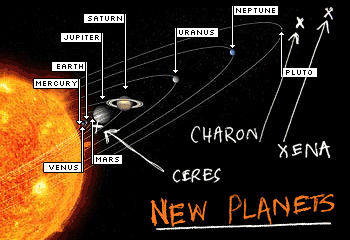
It's official. There are only 8 planets in our solar system. Pluto has been demoted to the status of "dwarf planet." This was decided by a vote during the congress of the International Astronomical Union on August 24th in Prague.
This is not the first time such a demotion has occured. Ceres, in the asteroid belt was formerly a planet 150 years ago, but was demoted because many other objects in the asteroid belt would have been planets too. Thus the new term "asteroid" was created.
The solar system is made up in neat layers: the first four planets- Mercury, Venus, Earth and Mars are rock planets; then comes the asteroid belt; then comes the four gas giants- Jupiter, Saturn, Uranus and Neptune; lastly comes the Kuiber belt- ice objects that orbit the sun.
The new definition of a planet is: 1) Must be an object that orbits the sun. 2) Must have enough gravity of its own to make itself spherical. 3) Must have significantly cleared other objects from its path. 4) Must not orbit another sattelite of the Sun.
Ceres is not a planet because it has many asteroids in close vicinity. Ceres has been elevated to the status of "dwarf planet." Xena, Pluto and Charon (a satellite of Pluto) are not planets, due to their location in the Kuiber belt, in close vicinity to thousands of ice satellites.
Throw this trivia question at some one to stump them! How many planets does our solar system have? 9. Wrong- it's now 8.

Wednesday, August 16, 2006

Interplanetary Wars


August 24 is the date set for the showdown in Prague. There are two camps in Astronomical circles. One camp believes that the definition of a planet should be "any star-orbiting object so large that its own gravity pulls in its rough edges and produces a near-perfect sphere." The other camp believes that it should be based upon size and Pluto would miss the cut.
Three new candidates have been put forward that fall in line with the gravity definition. It is thought that the vote is likely to go through. The smaller camp want Pluto struck off the list. Their dissent over the matter is because the gravity definition would leave the door open for hundreds of new planets in our solar system. The size definition camp believe these smaller star orbiting objects should be called Plutons.
Personally I am rather excited that the holiday options for space tourism have just broadened. However I not relish teaching 100 planets to my daughter. So I think I lean towards striking Pluto from the list. Siberia is cold enough without going to Pluto.

Monday, July 24, 2006

Xena: Pluto's bane


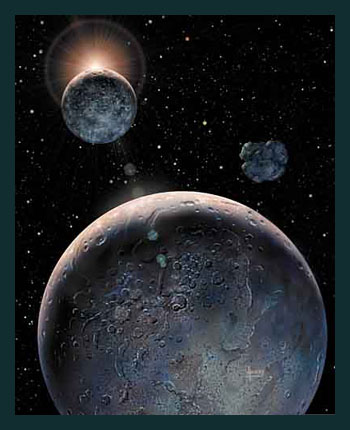
There is a vote of astronomers coming up in Prague on whether to officially add a tenth planet to the solar system. It is expected to get the nod. Officially it would call in to question Pluto's status as a planet as Pluto is much small than Xena. However Pluto is the only planet ever discovered by an American and so it is thought that as it holds cultural and historical significance, it will be allowed to stay.

My thoughts though surround the fact that such a big deal was made over man landing on the moon in 1969 and nearly 40 years later there is still no base on the moon. The moon would make a wonderful launching pad for exploring the rest of the solar system. I think that as humanity we have dropped our game a bit. To me it seems that the motivation for landing on the moon was far more miltary and political than scientific- an outcome of the cold war. At least there is a new super power rising in China and their space exploration, this may get the race going again.

We have a duty to explore God's creation, it is part of our worship to him.